Unlock the Editor’s Digest for free
Roula Khalaf, Editor of the FT, selects her favourite stories in this weekly newsletter.
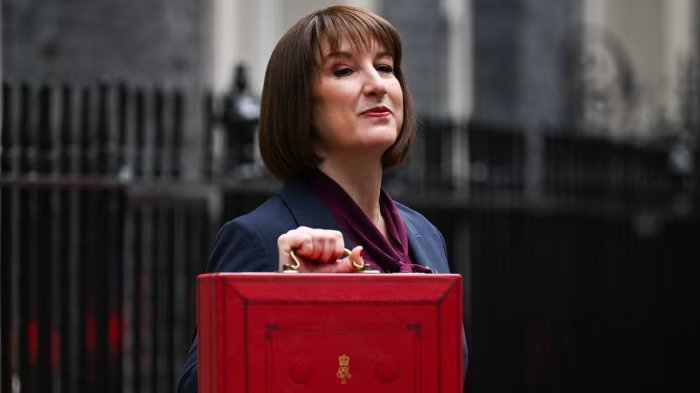
The UK borrowed almost £100bn in the first half of the financial year, the highest amount since the pandemic despite some favourable revisions, underlining chancellor Rachel Reeves’ challenges ahead of a tough Budget next month.
The £99.8bn total for April to September was £7.2bn more than forecast in March by the Office for Budget Responsibility, the fiscal watchdog, and £11.5bn higher than in the same period in 2024.
“If this pattern persists — and economic growth delivers less tax revenue than we’d otherwise expect — it could worsen the fiscal arithmetic facing the chancellor at November’s Budget, and beyond,” said Nick Ridpath, research economist at the Institute for Fiscal Studies.
Tuesday’s borrowing figure was the second-highest April-September total since monthly records began in 1993, topped only during the pandemic in 2020.
It came despite a downward revision of £4.2bn to previous borrowing estimates for the first five months of the period.
The IFS said the overshoot was striking, since the economy had grown faster than expected and inflation had overshot the OBR’s March forecasts — which would usually boost tax revenues.
Figures for the latest month showed the government borrowed £20.2bn in September, also a five-year high, albeit only slightly above the OBR’s £20.1bn forecast.
The data from the Office for National Statistics comes just weeks ahead of the November 26 Budget, when Reeves is widely expected to raise taxes further to fill a fiscal hole estimated by some economists at between £20bn and £30bn.
They are the last monthly figures to be published before the OBR finalises the fiscal forecasts on which the chancellor will base her decisions.
Robert Wood, at the consultancy Pantheon Macroeconomics, said the figures provided “a difficult backdrop to the Budget”, even though the outlook had improved as a result of the ONS revisions.
“Borrowing is still overshooting the March 2025 forecasts materially,” he said, adding that the OBR was likely to assume that the trend would persist to some extent in the medium term.
Analysts noted that borrowing on the key measure for the chancellor’s fiscal rule, to balance the current budget by 2029-30, was £13bn higher than the OBR’s forecast, a still bigger overshoot than for overall borrowing.
The OBR said the overshoot was largely due to higher estimated borrowing by local authorities and public corporations. Both tax receipts and spending by central government were broadly in line with its March forecasts.
The recent performance of the public finances will be only one factor in the OBR’s forecasts for the next five years. Other judgments, such as the watchdog’s view of the outlook for productivity — which it is expected to downgrade — would play a bigger role.
But Ridpath at the IFS said that even after the revision, the figures for VAT receipts were surprisingly low, given the recent and unexpected rise in inflation.
This raised the “unwelcome prospect that the government may feel the cost pressures that come with additional inflation without experiencing any benefit through higher tax revenues”, he added.
Ruth Gregory, at the consultancy Capital Economics, also noted surprise that tax receipts had not been higher, as the economy “hasn’t been terribly weak”.
In response to the ONS release, James Murray, chief secretary to the Treasury, said the Labour government would never “play fast and loose with the public finances”. He added that, according to IMF data, the UK was “set to deliver the largest primary deficit reduction in both the G7 and the G20 over the next five years”.
But for the opposition Conservatives, shadow chancellor Sir Mel Stride accused Reeves of having “lost control of the public finances”, adding that “borrowing is soaring”. He said “the next generation are being saddled with Labour’s debts” and that the chancellor was “plotting to hike taxes yet again to pay for her failures”.
About half of the £4.2bn downward revision for the first five months of the financial year was due to the correction of a previous underestimate of VAT receipts, which the ONS had already disclosed.